„History museums are the treasure houses of the past.“
In conversation with Jan Daniluk, Senior Subject Librarian in the Research Department of the Museum of the Second World War.
The Museum of the Second World War was founded in 2008 and receives over 600,000 visitors per year (2025).
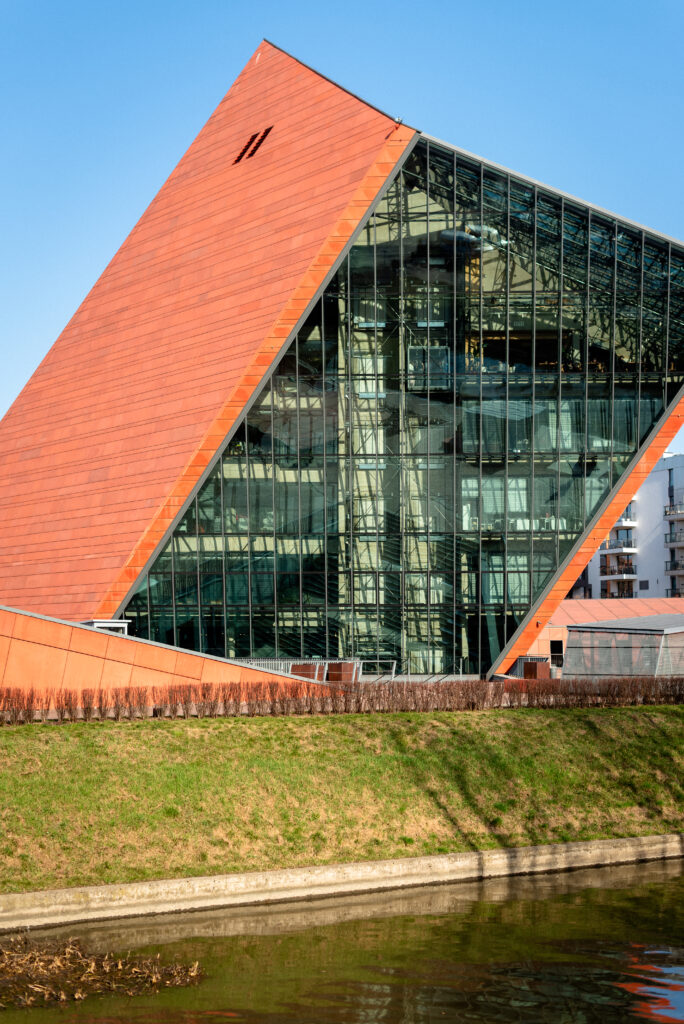
In the Polish city of Gdańsk stands one of Europe’s most ambitious history museums: the Museum of the Second World War. Through a vast permanent exhibition, it brings home just how profoundly perspective shapes the way a war is viewed and remembered. The museum places National Socialism in direct relation to Stalinism, framing the war in a European rather than a national context — a stance that has already brought it under political pressure more than once in its short history, but one which, under its current director Rafał Wnuk, it takes up again with clarity: as a place against forgetting, and against war.
Cornelius Puschke spoke with Jan Daniluk on the sidelines of our visit to the Museum of the Second World War.
Cornelius Puschke (CP): Dear Jan Daniluk, first of all, I’d like to thank you for having this conversation in German. We are here at the Museum of the Second World War, and I am well aware of the role we play as Germans coming here.
Jan Daniluk (JD): My pleasure.
CP: To begin our conversation, could you tell me about the history of the Museum of the Second World War — its origins and how it became what it is today?
JD: The Museum of the Second World War in Gdańsk is a state institution founded in 2008. In the years that followed, the collections were assembled, the museum was built, and it opened in 2017. Currently, nearly 160 people work here. In Poland, there is a great deal of interest in history, particularly in the period from 1939 to 1945. The Second World War plays a significant role in collective memory culture. That is why our museum is the subject of much discussion, and we receive many visitors. However, our projects do not serve domestic political purposes; rather, we are an active partner in various international projects. We are 100 per cent funded by the Polish Ministry of Culture and National Heritage.
„The permanent exhibition is located underground, at the lowest point of this building. That is no coincidence. We have buried the history of evil, of horror, of war underground.“
CP: What is your role here at the museum, both in its establishment and today?
JD: I work in the research department. My research focuses on the German prisoner-of-war system during the Second World War. From 2015 to 2017 — that is, in the period immediately preceding the museum’s opening — I was one of approximately 20 curators for the permanent exhibition.
CP: So you played a key role in the entire development of the museum, and especially the permanent exhibition, but then chose to pursue a career at the university.
JD: Yes, after 2017 I decided to work at other institutions. Now I am employed at the university, and a few months ago I returned to the Museum of the Second World War in a different role.
CP: Now that we are discussing the concept of the museum, the exhibition, its mission and its goals, I am very interested in the perspective from which all of this was developed, including its organisational structure.
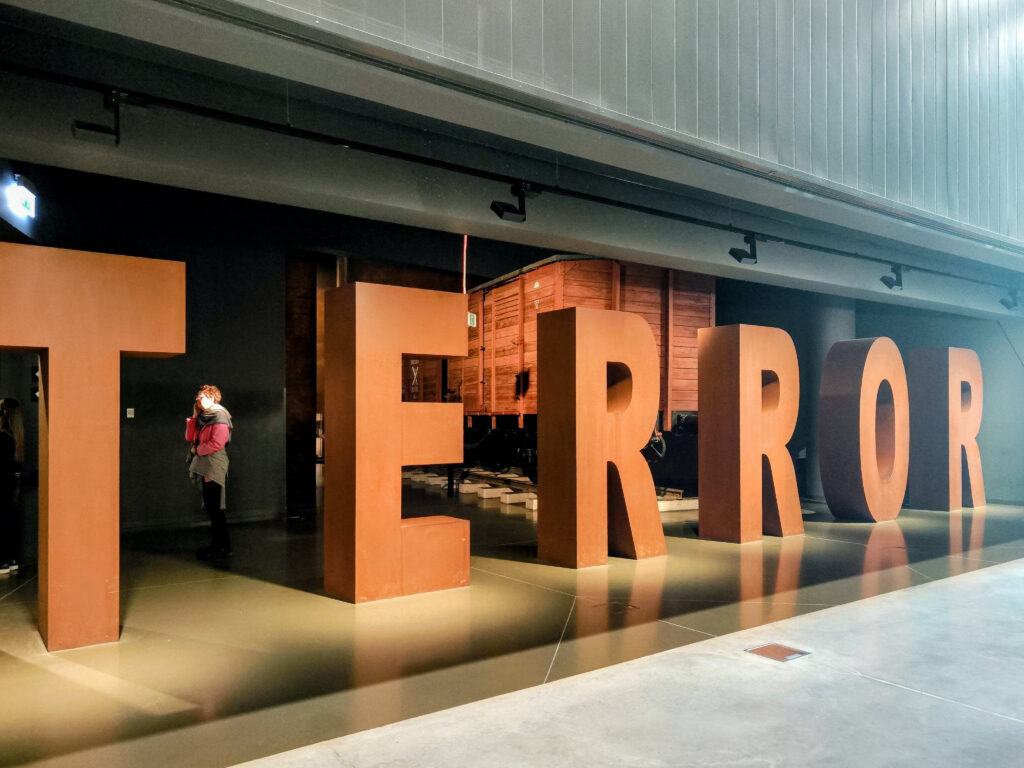
JD: We are talking about one of the largest permanent historical exhibitions in Europe, covering an area of 5,000 square metres. The permanent exhibition is located underground, at the lowest point of this building. That is no coincidence. We have buried the history of evil, of horror, of war underground.
And as the name suggests: it is the Museum of the Second World War. Not the war from a Polish perspective, nor from a European perspective. It is about the war as a global event. There is nothing else like it anywhere in the world. That is why we also have a section on the Japanese occupation in East Asia. It covers the Soviet Union and the battles in North Africa. With the permanent exhibition, we want to emphasise that the largest number of victims during the war were civilians. And we want to portray the complexity of the histories of Eastern European countries, because we as Poles know that this is not always easy to understand for people from abroad — from Western Europe, the Americas, and also Asia. There was not just one occupation here, but multiple ones: first the Soviet, then the German, then the Soviet again. That is why the term “liberation” in the context of the end of the war carries a completely different meaning when we think, for example, of France and Norway, compared to the Baltic states, Poland, or the former Czechoslovakia.
CP: From an academic and curatorial perspective, recounting the effects of the Second World War in South-East Asia is a very different task from doing so in Poland or North Africa. How did you approach this structurally?
JD: We did not organise it based on the experiences of nations or ethnic groups, nor from a geographical perspective, but rather around themes such as hunger, resistance, terror, occupation and collaboration, war crimes, and the daily lives of soldiers. At the outset, however, we did not have a single artefact. So first we built up our collection. Then came the concept for the permanent exhibition, and only then did construction of the new museum follow. It was a relatively unconventional sequence. That was the first phase. After the opening of the permanent exhibition, the second phase followed. Now we have reached our goal. We have made it. This museum is our tool, and we want to do more with it.
„In war, there are no winners — only sides that have lost less.“
CP: How did you handle the fact that, on the one hand, this museum is located in Gdańsk — a city that was particularly hard-hit by the Second World War — and, on the other hand, you want to provide a global perspective?
JD: There were many problems and disputes during the creation of this permanent exhibition regarding the question of how and what we should display. Even the smallest details played a role — the order of things, which terms we use, why one object is positioned closer to the centre of the room than another, and so on. That was the most difficult task. We had a programme committee consisting of Polish historians from various cities and regions of the country, as well as academic representatives from other countries, such as Germany, the United Kingdom, the United States, Israel, France, and Russia. We wanted to integrate these diverse perspectives into our work and handle them with sensitivity. And, of course, this led us to encounter a whole series of errors and contradictions. But it was precisely this enormous and difficult task that ultimately produced the wonderful result.
CP: In Germany — and I believe the same can be said of Poland — the public political discourse surrounding memory culture has changed significantly. It is more contentious than ever and has taken on immense significance. The various political camps all have their own truths and use them to make demands on public institutions, on politics, and especially on cultural institutions that have a mission to engage in memory politics. I know that you face, and have faced, this pressure here at the museum as well.
JD: Yes, for some, our permanent exhibition was not heroic enough, too pacifist, and not Polish enough. These people refuse to understand why this museum was founded. In war, there are no winners — only sides that have lost less. War is not an adventure. History is not a weapon, especially not for politicians. It is an educational task, and at the same time, there are hardly any eyewitnesses left who still remember that period. That is why this work of remembrance is our responsibility. And at the same time, we must look to the future and ask ourselves: what do we do next? We are an institution for discussion, for debate, and for cooperation. We want to be a partner in international relations. It is about an exchange of thoughts, an exchange of ideas.
CP: I think it is important and encouraging to hear that you want to pursue and further develop this international approach. At the same time, the current President of Poland, Karol Nawrocki, was the director of this institution for several years…
JD: I know him personally. We worked together for several years before 2015 at the Gdańsk branch of the Institute of National Remembrance.
CP: …and he, of course, stands for a different political vision.
JD: That is right.
CP: Not a vision of international engagement and global perspectives, but one that openly advocates placing Poland at the centre of memory culture. Now he is no longer the director of this institution, but the president of this large country. What is the relationship between the institution and his presidency today?
JD: I always say it is good that things change. It is about democracy in the contemporary sense. We can live together in the same country. He is our president. I respect him. I may not agree with him on various issues, but the museum continues to function.
„For us, it is about truth, objects, and rigorous educational work — especially in these politically turbulent times.“
CP: Undisturbed and unaffected?
JD: Yes. It is true that politically things have been moving in a different direction for several years now, but our main tasks — such as building the new outpost on the Westerplatte Peninsula, the free development of scientific work, and the creation of new exhibitions — remain unaffected by that. All of this continues. Do you know what is really important to me? I was there when this museum was still under construction. What we have created exists and will continue to exist. The exhibition is so large that it would be impossible to change the entire concept. It is like a perpetuum mobile — it just keeps running. We are not a small museum; we play an important role, and not just in Poland. It works, and that makes me very happy.
CP: That is good to hear. As part of the Übermorgen programme, we are very interested in how cultural institutions will develop in the future, and what cultural institutions themselves can do to shape their own future rather than having it shaped by others. What does the “Übermorgen” (day after tomorrow) look like for the Museum of the Second World War?
JD: We should strengthen ourselves and ensure our stability. There are many projects focused on history — in Poland, in Germany, and around the world — and museums are playing an increasingly important role. Do you know why? Because it is all about the objects. Especially after the COVID-19 pandemic and the massive digitisation of our daily lives, we long for interaction with real, physical objects. And suddenly, museums began to play an ever more significant role. For us, it is about truth, objects, and rigorous educational work — especially in these politically turbulent times. History museums are the treasure houses of the past.
CP: If I may add one final thought: I believe that museums and cultural institutions in general are places where people come together — in all their differences, their identities, their perspectives on wars, on memory culture, on nationalities. That is why I am so grateful to meet people like you and to be able to have this conversation, because I believe that these kinds of encounters must not remain singular, but that we should continue to develop them.
JD: Yes, of course. Museums must be a place of encounter for different groups, for different people.
CP: Dear Jan Daniluk, thank you very much. Here’s to many more fruitful meetings and encounters.
Hard Facts
Museum of the Second World War
Year founded: 2008
Number of employees: 160
Annual budget: 30 million złoty (approximately 7 million euros), plus revenue
Legal form: State cultural institution
Number of visitors per year: 620,749 (2024)
Type of events: Special exhibitions and an extensive accompanying programme (including events for school groups); regular curatorial tours of the permanent and special exhibitions; book presentations and historical discussions; academic conferences (including in cooperation with partner institutions); seminars and open discussions (also on topics relating to war more broadly and to current conflicts); cultural festivals; film screenings in the museum’s own cinema; theatre performances (both in partnership with external partners and by the museum’s own theatre group); historical picnics and outdoor events.