“It should never be ready.“
Im conversation with Prof. Dr. Marjan Doom,
Director of GUM Ghent University Museum
The GUM Ghent University Museum opened in 2020. The Botanical Garden was founded as far back as 1797 and has been at its current site since 1902.
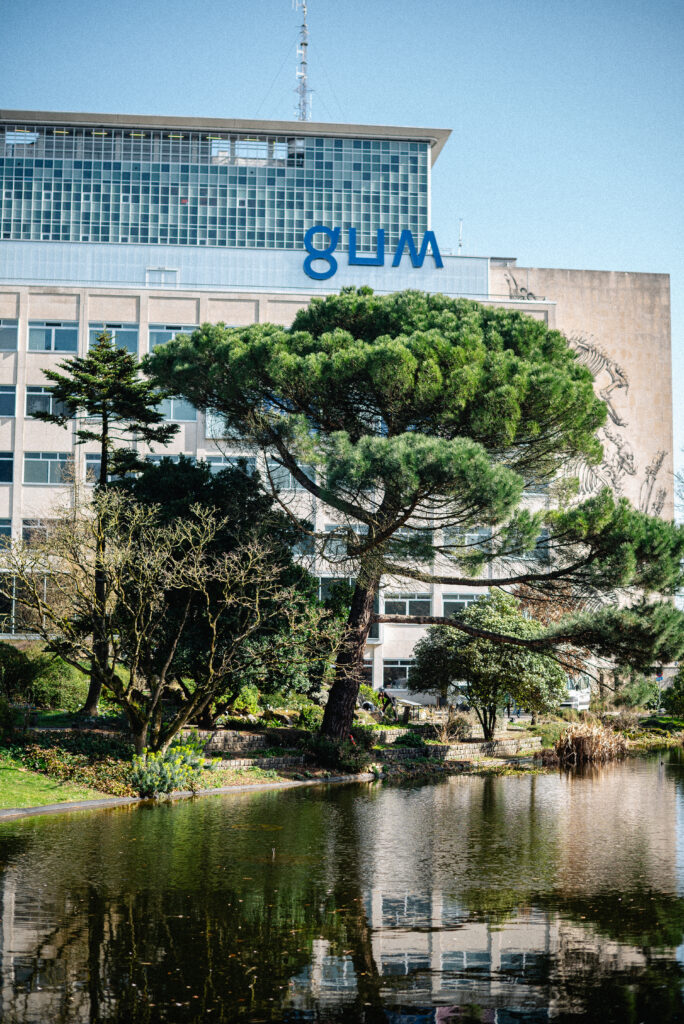
Nestled in the immediate vicinity of Ghent’s grand and well-known museums, the GUM – Ghent University Museum – is a rather singular science museum. From a wealth of disparate scientific collections, its director Marjan Doom has, guided by a clear concept and a remarkably free approach to the exhibits, created a place that poses fundamental questions about the foundations and limits of science. Her target audience is the extraordinarily large number of young people in this university city – yet, free of playful gimmickry and with a great deal of care for staging, the GUM stands as a testament to the power of conceptual rigour.
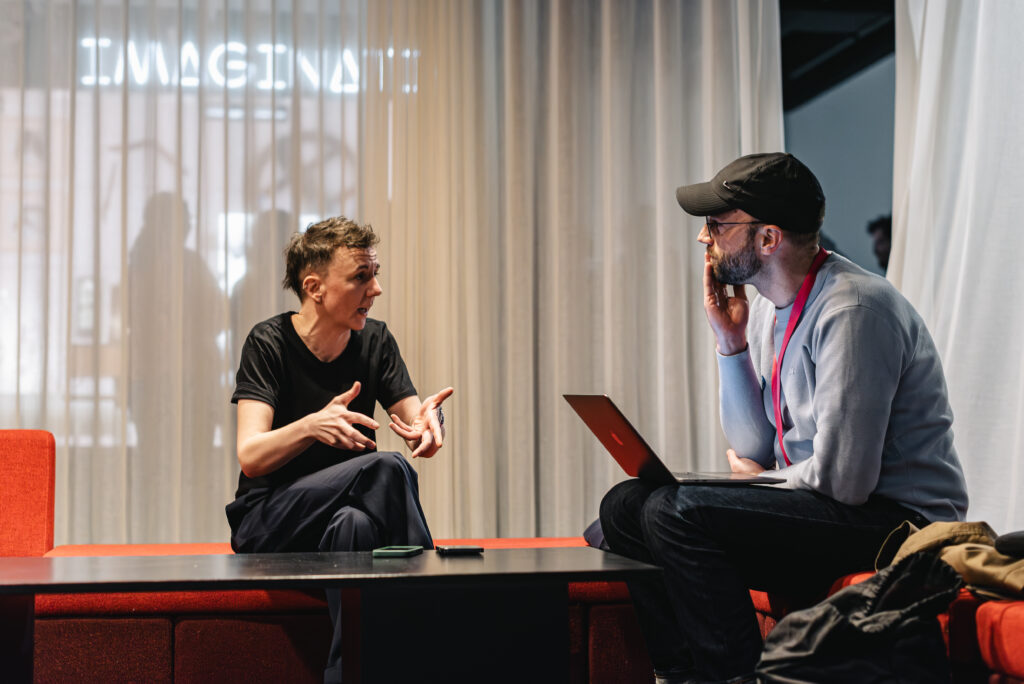
Cornelius Puschke spoke with Marjan Doom on the sidelines of our visit to the GUM.
Cornelius Puschke: The GUM is a relatively young institution with a long tradition. Could you tell me a bit about the history of this institution, its collections and how it came to found the GUM in 2020.
Marjan Doom: The university of Ghent is more than 200 years old. The academic collections started in 1817. Before 2020, all those collections were dispersed throughout the campus, many objects stood or were stored in hallways, attics and cellars. 25 years ago, the idea arose to protect all those collections and to found a museum where they would become accessible to the public. The final decision to make this investment was made around 2012-2013. At that time, I was one of the people working on the collections at a faculty.
„Often exhibitions start with a centrepiece and a decision what to show. And we did it the other way around.“
CP: So you were there already before the decision of the foundation was made?
MD: Yes, I was working on the anatomy collections. We were a small group of six working on different locations and at that time, we came together more often to create a collection policy. I started to experiment with smaller exhibitions ex-situ, in the city at various locations and out of that grew the idea to curate a permanent display. It was a very important step of the university to give trust to this, I would consider myself young at that time, with a very young and small team. They could have easily given the key to a big company and said: Create a museum. But they didn’t. So it was really one of the most beautiful times of my career. First of all I started with the mission and vision of the museum – What is the narrative? Who are we going to be? Who are we talking to? – rather than looking at the collections and deciding what we should display. Often exhibitions start with a centrepiece and a decision what to show. And we did it the other way around. Once the mission and the narrative was ready, I started to dive into the collections to figure out how to tell a story. Another big decision was not to create a museum on the history of the university but on scientific thinking. Over the years our focus shifted from the scientific process to research methodologies. The artistic research process is also very present here today. That’s why I call the GUM a research museum, not a science museum.
CP: There is another important word in your mission: doubt. When you started to work here as the director of the museum, you wrote a book, The Museum of Doubt, which I would describe as a manifesto or mission statement for the GUM, like a new software. What is the Museum of Doubt in your understanding, especially when it comes to science?
MD: During the preparation time of the museum, I interviewed lots of scientists and asked them: What is science? And I was very frustrated because I got so many different answers.
They started to argue amongst each another, everybody claiming their own truths. Getting out of this dilemma was difficult. An important step in the further process was, to not tell what science is, but rather to explore with visitors what science can be. So I started to work on questions like: What does a philosopher have in common with a physicist? And a linguist with a botanist? And doubt was the only term they all had in common. They all agreed that you can never proclaim truth and that you always have to be open to throw your hypothesis away. For me doubt is the core of scientific thinking, but I’ve also learned that it’s such an important word for so many other knowledge creating disciplines, not just science. It’s also important in the arts. Doubting connects people if you don’t just want to be a follower and go into absolute certainties and truths.
CP: I understand this approach and understanding for developing a concept for a museum but on the other hand I ask myself what are the things that you don’t doubt but deeply believe in. Things that you are deeply convinced about.
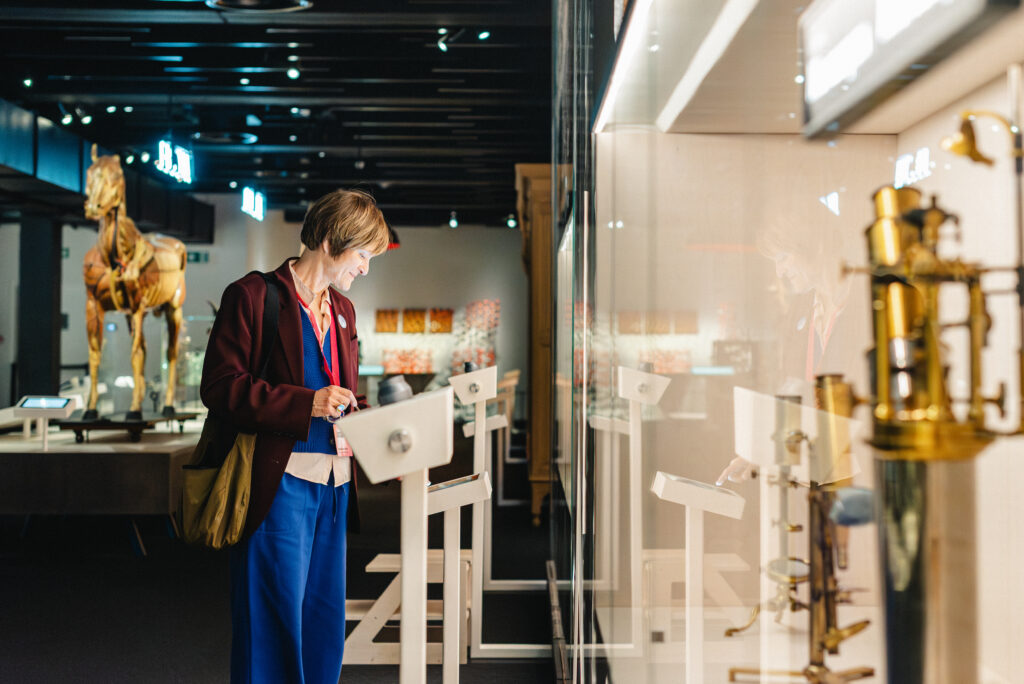
MD: I deeply believe in aesthetics and beauty because that’s something that you usually don’t connect to a science museum. Most of the time objects in science museums are displayed with lots of bright light and bright colors, they’re presented as knowledge carriers, whereas I think in our collections lies so much beauty. So that was another important decision: We’re going to display the objects as art objects and not just as tools. Our relatively dark light setting in this museum is evoking contemplation, it’s bringing out the beauty in the objects.
CP: So in your internal decision-making and the development of your curatorial concepts it plays a big role for your exhibitions how it feels, looks and sounds.
MD: Yes, that’s also the reason why we always work with theatre scenographers for the temporary collections because they create a different kind of experience. We understand our exhibitions as stages, like a set, a scenery.
„We never landed, we’re always in between.“
CP: When you wrote the book you probably also had to make rather practical decisions at the same time like how to shape the institution: Who’s in my in staff? What kind of structures do we need to develop this unique and bold vision? How did you make this whole thing practical?
MD: The way that you ask sounds as if everything would be ready and finished whereas I don’t feel like I’m ready. Everything is still in the making and in the experimental phase but like I said before, I think it’s important to stay in that making phase. We are a liminal organisation and my exercise is to keep it in this liminal phase and not let it land as an institution. It should never be ready. It should always be like something that can organically grow in order to feel what is happening in society, what is happening within the university. We are fluid and flexible. It’s a constant exercise to position ourselves within the academic and cultural field, in connection with museums and the arts. We never landed, we’re always in between. It’s not an essentialist approach. I think that’s a very healthy state for a cultural institution.
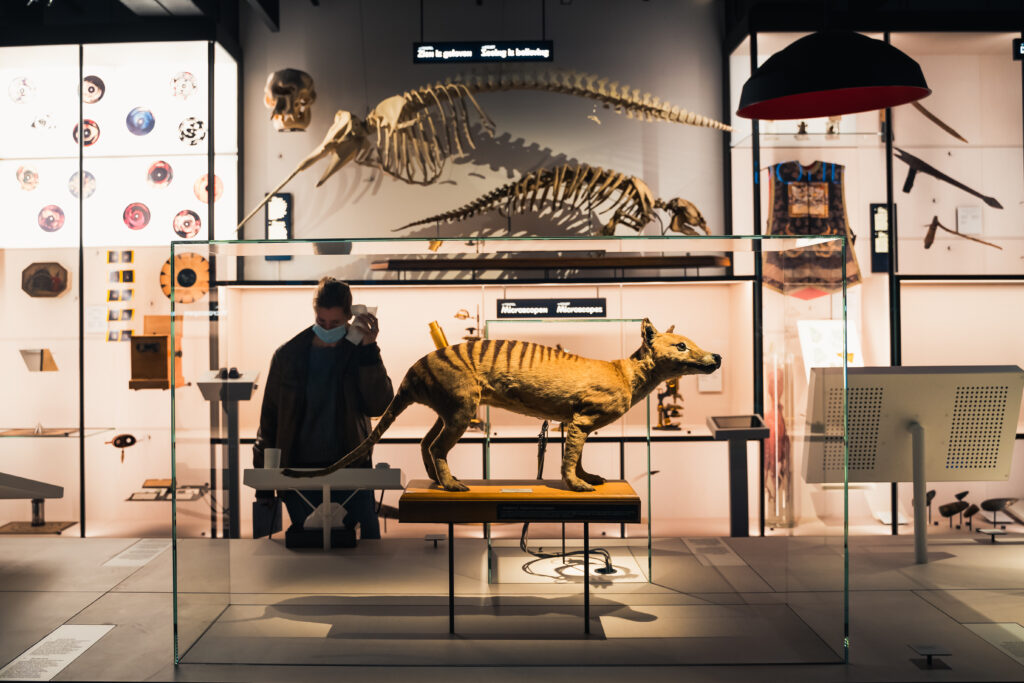
CP: When I was visiting the exhibitions and spent time looking at the objects and the way how you place them and contextualize them, there was one animal that resonated beautifully with the way how you describe your museum of doubt: The Tasmanian tiger wolf. Could you tell me a bit about that animal?
MD: It’s an animal that is extinct, although there are stories that it isn’t.
CP: Doubts…
MD: Exactly. It’s an animal that is not easily defined or put in taxonomy. It’s cute but it’s dangerous. It’s representing something that scientists are very curious about and something that humans really try to put in a box but it’s not possible. It’s a liminal, indecisive existence. So in that way, it connects strongly with who we are, yes.
„Bringing artists into a team can be disruptive […]. But for me, it’s constructive disruption. At their best, they are both co-builders and a thorn in the side.“
CP: How do you bring this kind of practice into your internal work? When you have meetings, when you have to make decisions about your strategy, what you are planning to do in two or five years, how much of your understanding of doubt or this liminality also feeds into your internal work and daily practice?
MD: I’m not leading this organisation like an institution. We’re at a time where lots of people would feel comfortable to land in certain routines. I break that up constantly. For example now I’m trying to install the housemaker programme for performing artists who are not just here as residents but become also members of the team. Bringing artists into a team can be disruptive, because they introduce a different way of seeing and thinking. But for me, it’s constructive disruption. At their best, they are both co-builders and a thorn in the side. This can be difficult sometimes but it’s a very healthy way to keep it dynamic and alive.
CP: A colleague of yours from the Manchester Museum, Ciaron Wilkinson, said: If you follow the same process, you get the same result. And I guess, if you don’t doubt the process, you don’t get a different result. Is this the reason why your exhibitions do look and feel differently?
MD: Yes, and it’s definitely not choosing the easy path.
CP: But it creates difference.
MD: Yes, you know I’m a veterinarian, anatomist by training, and I’ve always kept this kind of naïve approach into this field. I don’t come from culture or arts and I’m not a cultural scientist. So I had no blueprints in my head and I keep that kind of naivety consciously.
CP: I hope you can hold that for a long time and especially for the future. I wish you all the best for that. Thank you.
Hard Facts
GUM Ghent University Museum
Year founded:
The museum opened in 2020, but the botanical garden was founded in 1797 and has been in its current location since 1902.
Mission / Vision:
GUM & Botanical Garden want to provide an insight into how scientists think and work. They are a ‘Forum for Science, Doubt & Art’ that aims to connect and challenge visitors, scientists, artists and students to think critically. All of this is nourished, inspired by, and with great care for the valuable academic heritage collections of Ghent University.
Number of employees:
34 FTE
Number of visitors per year:
In 2025 we had about 94.000 visitors in GUM & Botanical Garden. The target audience is young people, aged 16 to 26. More than 40% of individual tickets (excluding schools) are purchased by visitors under 26.
Type of events:
GUM & Plantentuin, as a FORUM, enhance the scientific literacy of visitors, invite them into the world of doubt, and stimulate critical thinking through a polyphonic dialogue. Through exhibitions, publications, and public programming, GUM & Plantentuin engage in conversation with their visitors. The public program acts as a counterpart to the exhibitions: it further explores their themes through workshops, lectures, debates, artistic performances, and open conversations.
Website and social media links:
Website: https://www.gum.gent/en
Facebook: https://www.facebook.com/GUMgent/
Instagram: https://www.instagram.com/gumgent/
TikTok: https://www.tiktok.com/@gumgent
LinkedIn: https://www.linkedin.com/company/gum-gents-universiteitsmuseum-plantentuin/posts/?feedView=all
YouTube: https://www.youtube.com/@gumgent