“For me, it’s most important to listen to the youngsters.“
In conversation with Franky Devos, General Coordinator, and Kristof Blom, Artistic Coordinator of VIERNULVIER
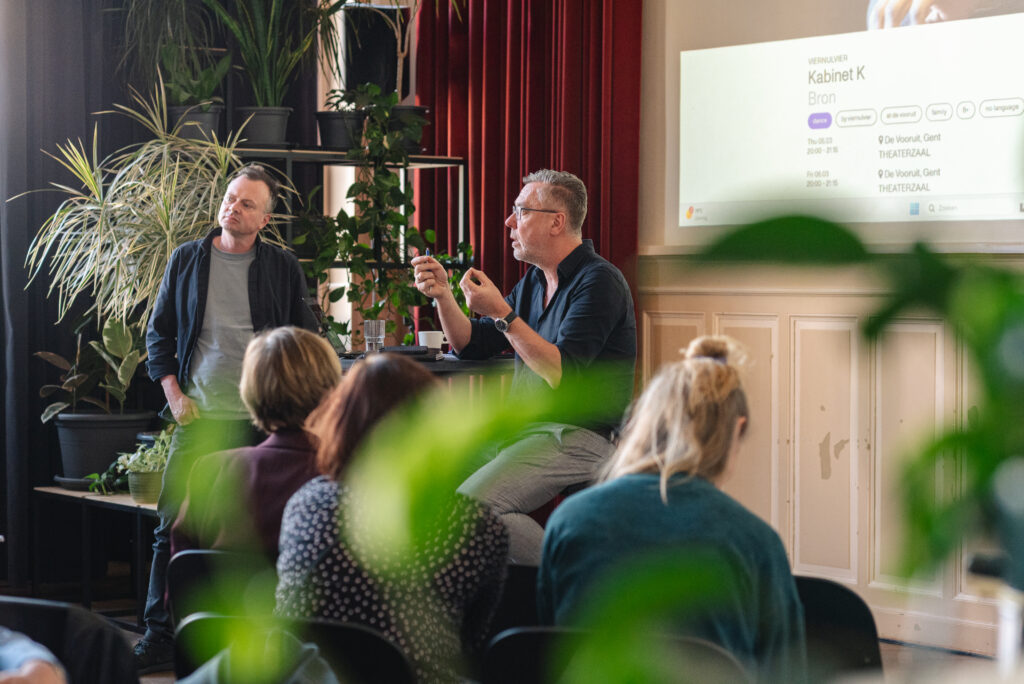
The VIERNULVIER was founded in 1913.
The Kunstencentrum Viernulvier in Ghent is renowned well beyond the borders of Belgium for its cross-disciplinary programme, firmly rooted in the heart of this storied Flemish university city. Only a third of its programme is shaped through conventional curatorial work. The greater part of its events, exhibitions, concerts and talks emerges from close collaboration with various actors and communities across the city, with the venue’s staff taking on a role of accompaniment rather than delivery. It is also for this reason that Viernulvier has gained an international reputation for its innovative organisational model, which establishes flat hierarchies for collaborative working through complex yet clearly defined decision-making structures.
Cornelius Puschke spoke about this with General Coordinator Franky Devos and Artistic Coordinator Kristof Blom.
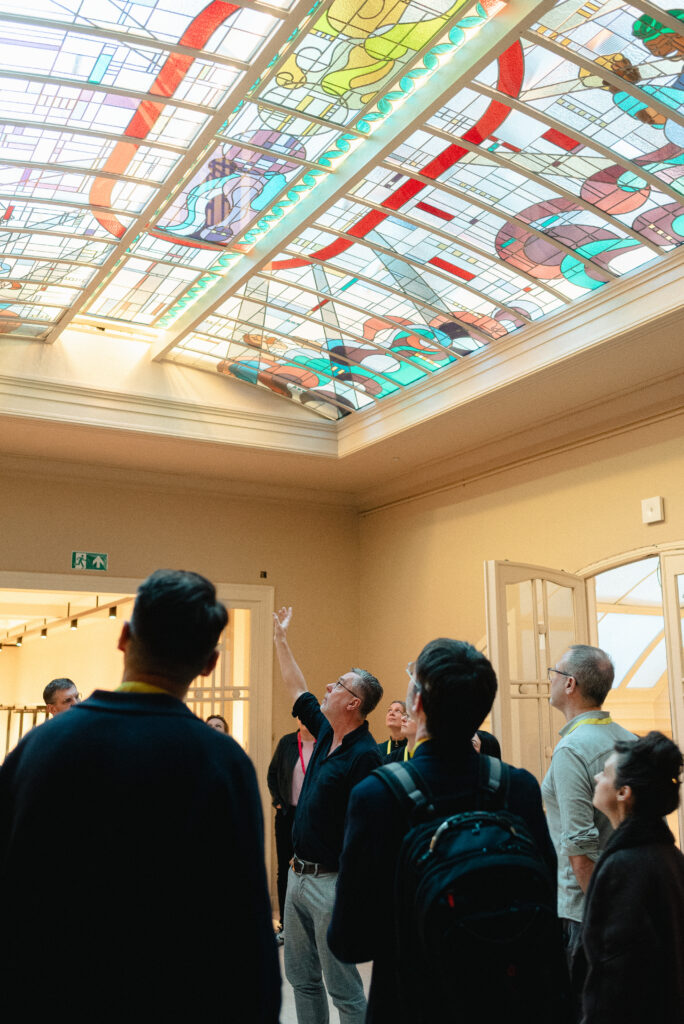
Cornelius Puschke: I would like to start the interview with the history of the Vooruit and viernulvier. When and how was this institution founded and how did it develop over time?
Franky Devos: This building was built in 1913 by the socialist movement. It’s a people’s house, a place where culture could happen for all the people who couldn’t afford it at that time. The Vooruit incorporated a lot of associations, a library, there were theatre plays and so on. It all went well until the 1960-1970s, where the restoration of the building required too much time and money. Due to the rising popularity of cinema and television, there were fewer people coming to this place. And then in 1982, there was a bunch of young people – many of them were unemployed at that time, so they had time and got the keys from the owner of Vooruit. They got the opportunity to start working on the development of an arts centre. In September 1982, they became independent from the socialist movement and started a programme of theatre, dance and music. In 1983 the building was protected by the Flemish government and they got financial resources for the restoration. From that moment on, Vooruit grew as an independent arts centre. In 2017, we became one of the seven main arts institutions of Flanders.
„This crisis changed everything.“
CP: A few years ago the name Viernulvier came into place and the name wasn’t the only new development. You also became famous for your internal organisational practice. Could you elaborate on that?
FD: In 2013 Vooruit celebrated its 100th anniversary. The whole team developed an amazing programme on top of the regular workload. But they also got a budget cut of 1 million Euros. This combination became the perfect recipe for an internal organisational disaster. There were fundamental internal fights about the management of the institution, also related to the question how to deal with the budget cut. There were people who ran into a burnout because of too much work that they had to do. This crisis changed everything. They said: “Listen, it’s not working anymore that there is a board of directors with only five people who decide what we all have to do. We are clever enough, we are motivated enough to set up a different model of organisation.” That’s how it started.
CP: So the crisis was the initiating moment for developing change by asking, challenging, doubting the own processes of working. But you also have to have a certain knowledge to do that, no? Where did this come from?
FD: It was learning by doing. Most of the knowledge came from the heads of the people working here. I don’t think that someone from outside the organisation can bring in so much knowledge. The employees themselves know how to solve situations when they are confronted with decisions made on tables where they themselves are not seated.
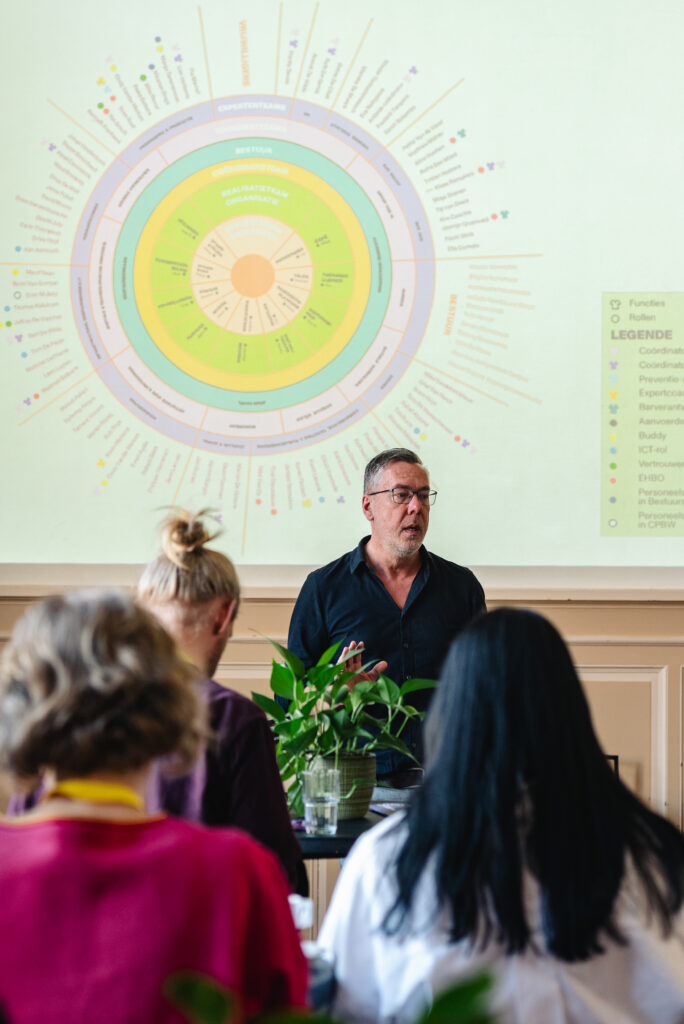
CP: One outcome of this change process is a famous organigram that you developed. You use it for your organisational decision making. Now, many institutions have similar organigrams, but in the daily practice they are forgotten and unused. Nobody looks at it. Could you please describe what your organigram is about and how you actually use it in your everyday work?
Kristof Bloom: I have worked here for a year and I can say it’s a very different way of working compared to where I come from. All the organisational models are really brought into practice. I was amazed by the protocol when I arrived here. There are some very clear guidelines. It’s not a theoretical model at all.
CP: So it’s an applied model but you also mentioned earlier that you don’t see and use it as a model but rather as a tool that accompanies your process of working. How is the daily practice with it? How do you use and also change it?
„We developed a procedure and rules about how we are making decisions with the goal that the responsibility is not always on the same table.“
FD: We regularly look at the design of the model and ask ourselves what doesn’t work. Are there problems we are facing that we don’t have an answer for? For example, what if we have to decide something immediately? Who is doing that? We developed a procedure and rules about how we are making decisions with the goal that the responsibility is not always on the same table.
CP: So there’s not only one table where one director sits alone, but rather many tables with changing places?
FD: Yes, there are a lot of tables and that is great. So many people are used to work on their own table with their own specialists. In many organisations this separation is often the start of a conflict because people tend to think that their own team is doing a great job and it’s always the fault of the others. Because you don’t know them well and you don’t know what they are doing. What we try to do is to minimise the activity around one table with all the same experts.
CP: From my point of view you use two main languages for this. One is the visual language of the organigram that displays in a transparent way how you organise yourself internally. The other thing is a specific vocabulary. I learned that you speak about functions on the one side and roles on the other side. Could you please describe why this is important?
FD: And the third thing is mandate. The function is really the job that you are doing, you are specialized in, your position so to say.
CP: Like general coordinator for you or artistic coordinator for Kristof.
FD: Exactly. But it’s a role that Kristof plays in a team. We need him for his knowledge, but he also has to come to a decision together with people from other teams. And this understanding of a role applies to everybody. In the next meeting somebody else can be the leader. The role is not fixed to your function.
CP: It’s in flux.
FD: Yes. And the third thing is mandate, of course. I can give you a role, but if you don’t have the mandate to decide, it’s a big problem. Because then you have the responsibility without the mandate to change. And if you want to bring people to a burnout, that’s a very good recipe.
KB: You have the freedom to take on different roles. This is the great thing. For example, if I would be interested in the question how the kitchen works, I could play a role in that. My feeling is, being quite new here, that this organisation is carried on so many shoulders. A lot of people feel responsible for things outside their domain.
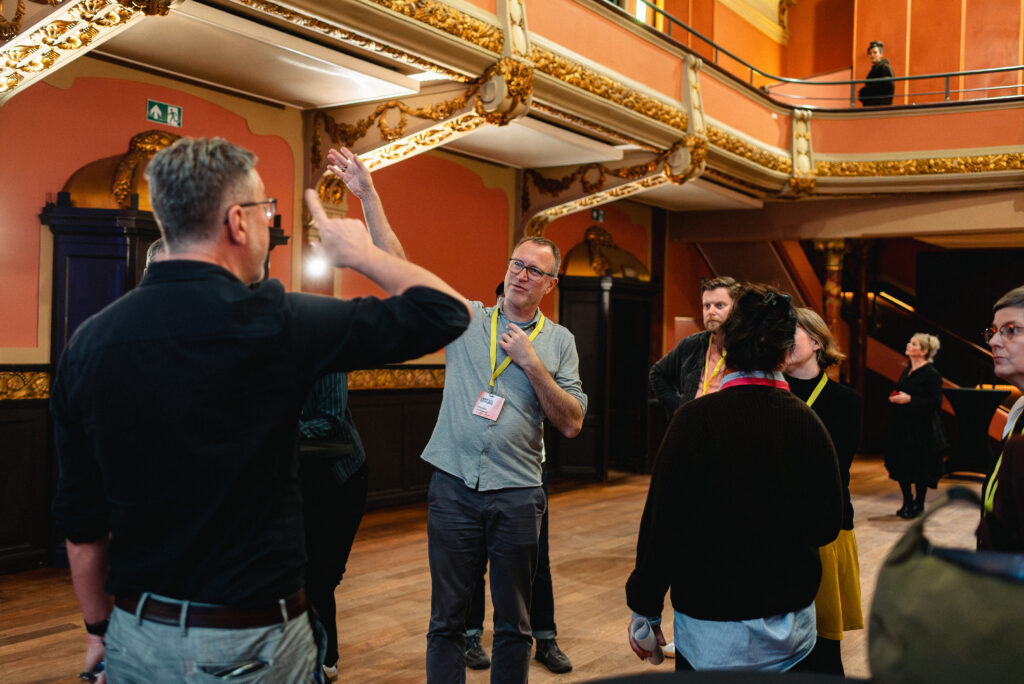
„And it’s also beautiful to see people growing through this because they take care of other responsibilities or share it.“
CP: By carrying the weight on many shoulders, you found a way, through your model, to make the everyday work much easier.
FD: Definitely, yes. You can’t carry everything alone. And it’s also beautiful to see people growing through this because they take care of other responsibilities or share it. You’re not only a good bartender and that’s why you are a bartender. Maybe you also have very inspirational thoughts on how we could develop on sustainability.
CP: And how do you bring this into the decision-making of the teams?
KB: There’s the freedom to access the agendas of all the teams.
CP: So the doors are open for this and it happens.
FD: Yes, and we know each other. 90 people is not that much.
CP: 90 is a manageable number. You know everyone. How would it be with 300 or 500?
KB: Our model fits to the scale and the mission of our organisation. And it stands in the tradition of this house. That’s why it works. This model has grown into this building and its organisation.
FD: And we have a very practical knowledge of that, but no theoretical.
CP: Oh, really? I thought you were very much into organisational design.
FD: Not at all! We regularly have people here from universities who study this a great deal and ask me about theories. Sorry, I don’t know. I haven’t read 100 books about it. It’s the way it works here. Nothing more than that.
KB: It’s a very good example of a bottom-up model that has grown organically. This is also the reason why we are coordinators and not directors. It’s the opposite of top down.
CP: Interestingly most of the organigrams are pyramids. Yours is a circle.
FD: The design was made two years after we worked already like that. We didn’t make a design and then decided to follow it. Not at all. Instead, we asked someone to do the graphics but it is something that comes in at the end of our processes.
CP: With my last question I would like to come back to this moment of crisis that you mentioned earlier. If we talk about change management, institutional change, new ways of working, new ways of collaborating, fewer burnouts, a better way to invest your energy etc., crisis is very often the catalyst that leads to something new or a big institutional transformation. But of course the better change management would be a mode where you anticipate the coming of a crisis, where you’re seismologically sensitive enough to feel what is coming and develop the needed changes in advance. How do you anticipate crises that might occur in the future? How do you prepare yourself?
FD: For me, it’s most important to listen to the youngsters. We actively engage employees who are under 30 and we hear that they formulate completely other needs and expectations from their employer. We learn from them instead of blaming the Gen Z for anything. We installed a young panel, which is a group of 17 people under 30. The topics they put on the table are really disruptive for the way that we are doing things at the moment. And that’s great. But we ask them not only to put the problems on the table, but also to imagine a good future for this organisation together with us.
CP: I wish you that all the crises stay in the past and all the beautiful and good energy lies ahead of you in the future. Thank you very much.
Hard Facts
VIERNULVIER
Year founded:
1913
Mission:
VIERNULVIER is a central platform in a dense network of artists and organisations from a variety of sectors, informed and inspired by a turbulent world and an ever-evolving world of the arts. Maintaining a contemporary vision with respect to the future, VIERNULVIER seeks to facilitate greater cross-pollination between the arts and the local and global communities. We serve both as a welcoming meeting place and as a lab for development, production, presentation, participation and reflection. We continue to build on our proud history of innovation and social engagement.
Number of employees:
90 (73,85 FTE)
Annual budget (fixed budget, third-party funding, donations/private funds):
€ 11.500.000
Legal Form:
Non profit organisation / private
Number of events per year:
575
Number of visitors per year:
330.000
Type of events:
180 performing arts shows, 125 concerts, 5 albums released, 124 talks and debates, 15 food events, 73 nightlife events, 21 guided tours, 23 literary events / 8 movie screenings (in 2025)
Website and social media link:
www.viernulvier.gent
Facebook: www.facebook.com/VIERNULVIER.gent
Instagram: https://www.instagram.com/viernulvier.gent